
The Pillars of Creation: what the Webb telescope found inside the Eagle Nebula
An infrared view revealed protostars where Hubble saw only dust.
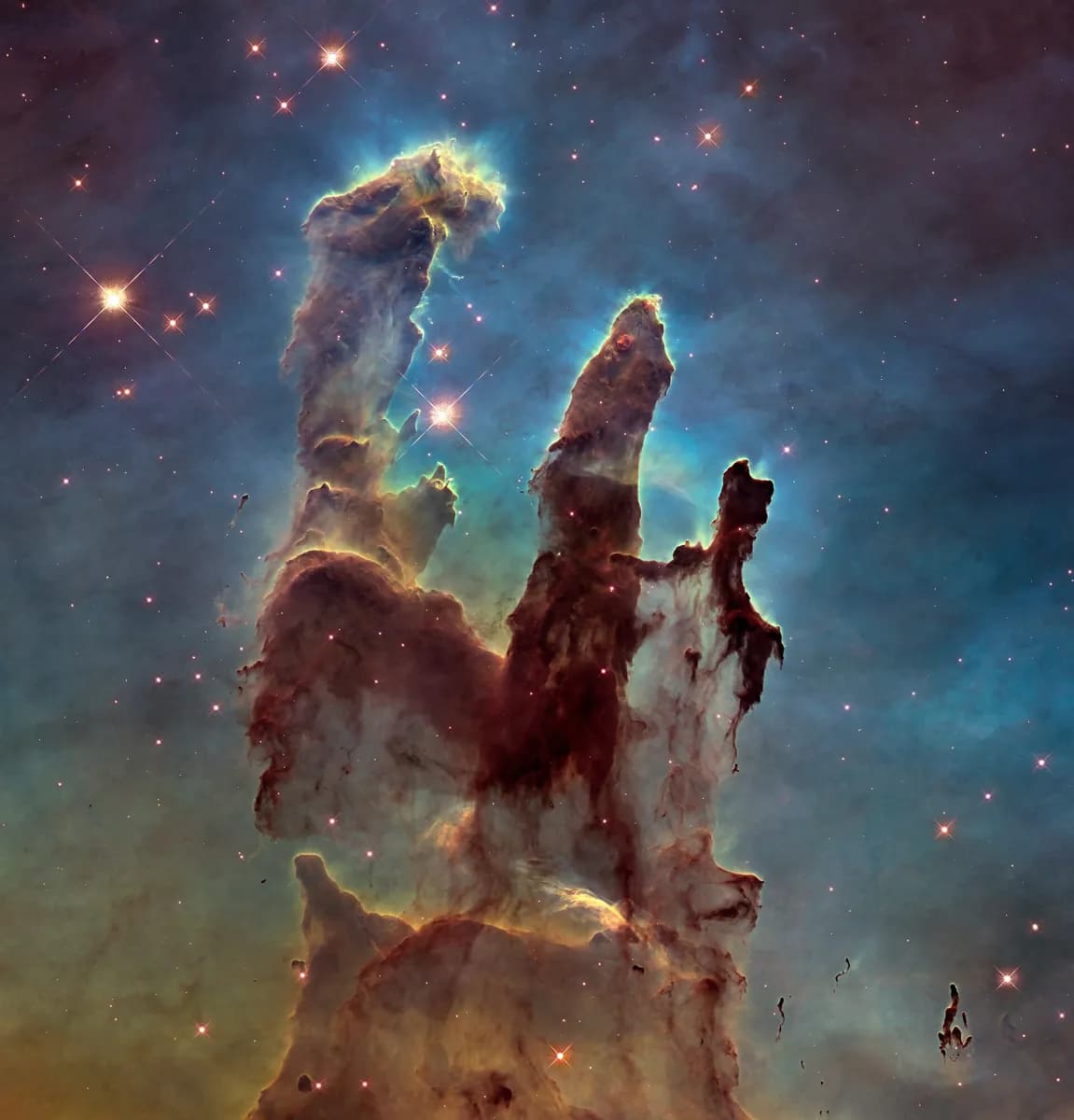
The Pillars of Creation are three columns of gas and dust in the Eagle Nebula, about 6,500 light years from Earth. The 1995 Hubble image made them one of the most recognisable astronomical pictures in history.
The James Webb Space Telescope observes in the infrared, and infrared light passes through dust far more easily than visible light. Where Hubble recorded an opaque wall, Webb resolved dozens of forming stars — bright red points at the tips of the columns.
The pillars themselves are the remains of a larger cloud that is evaporating under ultraviolet light from nearby massive stars. The process is called photoevaporation: the radiation strips away the outer layers of gas, while the dense clumps inside hold out longer and trail tails behind them.
The paradox is that the structure may no longer exist. One hypothesis holds that a nearby supernova destroyed the pillars about 6,000 years ago, and the light from that event simply has not reached us yet.